Showing posts with label Healthy Oceans Healthy Planet. Show all posts

Wednesday, 18 November 2015

Microplastics: the invisible battle for ocean health


When we talk about marine debris, and in particular plastic, the first thing that comes to mind for many people, is plastic bags and bottles. We have, in our efforts to reduce plastic use, have focused a great deal on these larger, more visible items. But they are not the only, nor necessarily the biggest, threat to the marine environment when it comes to plastic. Microplastics, nearly invisible to the naked eye and estimated to number over 5 trillion pieces are now considered a major issue. Before we discuss microplastics however, let’s recap on some important facts about plastic.


  • In 2014, the amount of plastic created reached a record 314 million tons, a whopping 38% increase on the figures for 2014 (Plastic Oceans, 2015)
  • Estimations of plastic waste reaching the oceans is between 4.8 and 12.7 million metric tons annually (Shim and Thomposon 2015, Wang et al 2016)
  • Significant increases in the quantities of plastic in the North Pacific gyre and waters near the British Isles have been recorded between 1972 and 2010 (Wang et al 2016)
  • Plastic is resistant to biological degradation and instead fragments into smaller pieces, never truly disappearing (Shah et al 2008, Webb et al 2012)


Image courtesy of Flora and Fauna, 2013

Microplastics; what are they?

Any piece of plastic that measure below 5mm in size are considered a microplastic (Li et al 2015, Shim and Thomposon 2015, Wang et al 2016). They are the most common type of plastic found in the oceans (numerically), accounting for 92% of the total number of plastic particles (5.25 trillion) or 13% of the total weight (Shim and Thomposon 2015).

There are two types of microplastic; Primary and (you guessed it) Secondary. Primary microplastics (sometimes called microbeads) are those that were purposefully created by humans for a reason. Those reasons could be for your facial scrub or cleanser type things, sand-blasting equipment or shower-gel stuff. Secondary microplastics on the other hand, come into existence through the fragmentation of larger pieces of plastic (through human breakages and UV light deterioration) (Shim and Thomposon 2015, Wang et al 2016)

These tiny little pieces of plastic can make their way into our marine environment through many different ways. Secondary are commonly born in the ocean, as lost plastic waste endlessly floats in the ocean it fragments under the sun’s UV rays. Primary microplastics find their way into the ocean through long migratory journeys. Some will be a result of poorly managed waste disposal or clean ups, whilst others (the cleansers) are so small they can be washed down the plughole and slip through every type of water treatment, straight into the sea. You have undoubtedly heard the saying ‘all rivers flow to the sea’, and this is true (albeit with some rerouting), so any plastic that reaches the ocean, especially microplastics, are likely to find their way there one day.


The Big Blue

What is next for these baby microplastics as they set out to explore the massive expanse of the ocean? Will they float aimlessly for eternity, drifting wherever the currents take them? Or will they sink down to the depths and become one with the sediment? Or, maybe choose to join the food chain and find themselves eaten? There is a lot of research that discusses the behaviour of microplastics in the ocean, but simply put, they can be split into three categories; Physical, Chemical and Biological.

Physical behaviour relates to their movement in the water, this could be through migration with the currents, or accumulation in one of the massive mid-ocean gyres and even sinking and resting with the sediment at the bottom (Wang et al 2016). On its own, the physical behaviour of microplastics doesn’t really present any concerns or problems with regards to environmental or health issues. However when we couple it with chemical and biological behaviour, it is a different story.

Chemical behaviour relates, primarily, for plastic to undergo chemical changes or absorption of chemicals. As already mentioned, ‘natural’ fragmentation or degradation of plastic can happen, though slowly (even slower in the ocean). This processes, which takes place when plastic is exposed to the suns UV rays, are called ‘photo-oxidative’ and ‘thermos-oxidative’ reactions and result in the polymer (plastics) to change its properties (strength, colour and shape) (Wang et al 2016)

As plastics are broken down into smaller and smaller pieces, the available surface area for a process of absorption increases, which in turn increases the rate of absorption. Research has shown the plastics are veritable sponges when it comes to absorbing chemicals. Persistent Organic Pollutants (POPs) are contaminants that remain in the environment for prolonged periods and can remain a threat to humans and wildlife. Some examples of potential POPs that can be absorbed include Polycyclic Aromatic Hydrocarbons (PAHs), Polychlorinated Biphenyls (PCBs) and Dichlorodiphenylytrichloethane (DDT) (Wang et al 2016, Webb et al 2012).


  •  There are approximately 100 PAHs out there that are released from burning coal, gas, trash, tobacco, wood and other organic materials. Needless to say, some of these are anticipated to be carcinogens and have been linked to lung, liver and skin cancers (US National Library of Medicine 2015).
  • PCBs are man-made organics. They were banned in 1979, but before that were used in products of wide variety (plastics, floor finish, oil, transformers and cable insulation to name a few). During their manufactor and from poor waste management, PCBs leached into the environment and once there, they don’t break down much (persistent!). They have been shown to cause cancer as well as issues with immune, reproductive and nervous systems. So these are bad (EPA, 2013)
  • DDT is probably more commonly known and was used as a pesticide until it was banned in many countries. Whilst it hasn’t been shown to cause reproductive or birth defects in humans, tests on animals found some species were susceptible to harm. Whilst humans exposed to it have claimed nausea, confusion, headache, vomiting and fatigue all occur (National Pesticide Information Center, 1999)


The ability for plastic to absorb these harmful chemicals may at first seem like a good thing, a way to get them out of the environment. However, due to the size of the microplastics, and the ease marine species have in ingesting them (even down to plankton!) it is concerning for the health of our oceans and ourselves. Plastic has the ability to absorb and concentrate chemcials, but in our bodies they have the ability to release them and store them in our tissue and fats. If we consider bioaccumulation or biomagnification, we can understand that as we ascend the food chain, the amounts of chemicals increases (based on the number of little fish the bigger fish has to eat, it accumulates chemicals from each of them. This is one of the reasons science says to avoid eating a lot of fish (Tuna!) more than once a week. Mercury and other chemicals are found in higher and higher concentrations which can result in poor health, birth defects and cancers; both for ourselves and life in the oceans. Basically put, our use of plastic is poisoning ourselves and the oceans.


So, in conclusion, we know that macro and microplastics are commonplace in the ocean, increasing annually and migrating across huge expanses of ocean. We know that microplastics are really small and easily ingestible by even the smallest of marine life and that because of this, they are more and more commonly found within the food chain, up to the top predators. We know that microplastics can absorb harmful chemicals and metals, which they store and can then release into body tissues and fats. We know that these chemicals can accumulate within species, and magnify as they move up the trophic level (food web). We know that getting microplastics out of the ocean is a huge challenge that is almost impossible due to the size of nets we’d have to use to collect them catching literally everything.

We also know how we can change this. The choices we make on a daily basis can influence the levels of plastic reaching the oceans. Here is a small list of things you can do to make a difference:

  • Don't buy needlesslypackaged items; there is never a need for a plastic wrapped banana
  •  Always check your shower gels and facial scrubs for the ingredients; Polyethylene, Polypropylene, polyethylene terephthalate, polymethlyl methacrylate or nylon. It is all plastic!
  • Pick up plastic trash when you see it on the floor and dispose of properly
  •  Stop using ‘single-use’ plastic and start carrying reusable bags and bottles
  • Campaign to have microbeads banned in your local state (a la California)
  • Volunteer with local NGOs working against waste


Help us help you. Change the World.


The Blue Temple Team


Bibliography


Li J, Yang D, Li L, Jabeen K and Shi H (2015) Microplastics in commercial bivalves from China. Environmental Pollution. Elsevier Ltd 207: 190–195. Available at: http://linkinghub.elsevier.com/retrieve/pii/S0269749115300658.
Shah AA, Hasan F, Hameed A and Ahmed S (2008) Biological degradation of plastics: A comprehensive review. Biotechnology Advances 26(3): 246–265.
Shim WJ and Thomposon RC (2015) Microplastics in the Ocean. Archives of Environmental Contamination and Toxicology. Springer US 69(3): 265–268. Available at: "http://dx.doi.org/10.1007/s00244-015-0216-x.
Wang J, Tan Z, Peng J, Qiu Q and Li M (2016) The behaviors of microplastics in the marine environment. Marine Environmental Research. Elsevier Ltd 113: 7–17. Available at: http://linkinghub.elsevier.com/retrieve/pii/S0141113615300659.

Webb H, Arnott J, Crawford R and Ivanova E (2012) Plastic Degradation and Its Environmental Implications with Special Reference to Poly (ethylene terephthalate). Polymers 5(1): 1–18. Available at: http://ehis.ebscohost.com.ezproxy.unal.edu.co/ehost/pdfviewer/pdfviewer?sid=9bbfdbf9-ecd6-4a32-ba36-682939850b58@sessionmgr10&vid=13&hid=2\nhttp://www.mdpi.com/2073-4360/5/1/1/\nhttp://www.mdpi.com/2073-4360/5/1/1/pdf.

Tuesday, 20 October 2015

Our Story


There was a time in the not too distant past where we were different. When I say we, I mean we at Blue Temple. A time where we didn’t think twice about our food consumption, or our waste creation, and yes, that was a time of relative simplicity and free of difficult choices, temptations and general feelings of upset.

Now, our lives require a lot more effort, result in a lot of self-questioning and pressure to behave in accordance with a set of personal rules, or norms. How we got here is not an exciting story, nor is it overly exceptional or complicated, if it was, that’d make an excellent blog, but it’d also eliminate the point of it. I want people to know how easy, with a little effort, it is to make small life changes that can change the world.

I went into my education at the age of 14, knowing that Geography, and then Environmental Science were my topics of choice, where my enjoyment led and heartfelt desire to work lay. So it begs the question, why did it take me another 15 years after my initial exploration of the wonders our planet offers to come to the now very obvious conclusions we see in Blue Temple? The answer, realisation that what I do CAN make a difference, to me, to my loved ones and to my environment.

Sabina is a very different story, she was raised in an environment where little care or attention was (or still is) paid to nature or conservation. She completed school studying computers, before relocating to the UK to learn English and eventually end up as a scuba diver with a BA degree. However, throughout it all, there was no focus on the environment, no teaching or education focused towards it. Sabina came to her conclusions through a growing love and care for everything around her. It was at this point, that she started (and continues) to learn about the risks and threats.


Two very different paths, one through education, the other through love and care, the same outcome. Working to protect our planet from ourselves. We are by no means perfect, far from it, but we try, we put in the effort to reduce our waste and our impacts. “One person doesn’t make a difference” I can you hear you all thinking, and maybe, you are right. But why should that stop you?

If you, like me, had the education to understand the damage we are doing to the planet. As individuals it is our duty to change the way we approach every day. With knowledge comes a responsibility. If, like Sabina, you love something, surely you should do everything in your power to try and protect it? Whether it is the trees in your back garden, or the beach you go for evening strolls. Litter, pollution and human action threatens everything.


You might still be wondering what we do that makes a difference, and you might say what we do is pointless, too much effort or even not enough, but we each do what we can and what we hope will result in change.

  • Meat Free Mondays and Fridays


We have spoken about it before, but the production of meat puts our planet under huge pressure. Land can be used more efficiently, water more effective and waste more suitably. Reducing meat consumption helps to reduce our impact as individuals and as a nation on our agricultural land

  • No Seafood


This one arose for multiple reasons. The first, as avid scuba divers, it seemed a bit irrational and backwards to contribute to the overfishing and destruction of the environment from which we get so much enjoyment. Second, we watched the 2009 documentary ‘End of the Line’, a short film about unsustainable fishing and the impacts it is having on our oceans, as well as emphasising the methods behinds the capture of such a massive magnitude of fish globally. Finally, we are what we eat. Fish eat plastic and mercury. We want to protect ourselves from that. (Recently, fresh water fish caught in the Thames were found to have plastic in them. Is no one safe?)

  • No Use for One Use


Plastic is well known to be a problem, if you don’t know, I’d be interested to know under which rock you are currently living. Plastic doesn’t biodegrade, it slowly (I mean, real slow) breaks up into tiny little pieces and ends up in the bellies of fish, mammals and animals worldwide. www.midwayfilm.com is an excellent short of an island 2,000 miles from human settlement that has been affected by our plastic waste. We have banned ourselves from using one use plastic, that includes plastic bottles, plastic cups, polystyrene and plastic bags.

These three, amongst others, including composting, not buying unnecessarily and reducing energy use have totally shaped our lives over the last year. With thanks to Dave for pushing us through. Our routine have slowly changed and refusing plastic bags, straws and cups has become habit. We have slowly, and with much difficulty, altered our personal norms so that we work our hardest to avoid these things. Obviously, when you are handed something in a plastic bag, and it is offensive to say no, then we take it, with the sole intention of reusing and ensuring it is properly disposed of.


It has been a difficult transition, and has resulted in long walks through the village to get our bags after arriving at the shop having forgotten them, that, or carefully balancing and cramming everything bought into one bag and waddling back to the house attempting to avoid dropping things. Not to mention forgetting what day it is and hastily avoiding meat dishes!

We could have just carried on, forgot our bag? Never mind, we will just get one this time. But then any impact our efforts have on local perspective would be damaged. To the locals, a plastic bag is the norm, we are the odd ones. But they accept it and now don’t offer us plastic bags, straws or other such stuff to us. If we were to continue with bad habits, what hope could we ever have to make a difference to them? We have to be role models to those who don’t understand, and leaders to those who need it.

We tell you all this not because we want praise, we want people to know that even the smallest effort can result in a huge change. Whether you reduce your car use or meat consumption, or start buying fresh, unpackaged produce, or stop one use plastic, we can all make a difference.

The joy you feel when you look at the sky on a sunny day, or when you feel the grass beneath your bare feet in summer or the smells the ocean brings. These are what make a life worth living, and your planet worth protecting.

This is your planet. Help us protect it.

Monday, 8 June 2015

Healthy Oceans, Healthy Planet; World Oceans Day Celebration


In the year 1992, the Earth Summit in Rio heralded a motion from the Government of Canada for the introduction of a day designed to celebrate and raise awareness for our oceans, 16 years later it was finally official and World Oceans Day was acknowledged by the UN and is celebrated annually on 8th June each year.

The theme for the year 2015-2016 has been chosen as ‘Healthy Oceans, Healthy Planet’, a theme dedicated to highlighting the importance our oceans have in our everyday lives, they are life-force that maintains balance to our planet.

We, amongst with millions of others focused on what actions we, as individuals and societies, can take to protect and safeguard the oceans for future generations of both humans and nature. We took a specific look at Plastic and its impacts on our beloved oceans.


Celebrating our Oceans in Pulau Perhentian
Some of you will already know that we are surrounded by stunning, tropical waters full of coral, fish and exotic species. So it should come as no surprise that we were keen to celebrate our oceans, and the importance they have with anyone and everyone we could get involved.

Due to the Department of Marine Parks event on the 7th and 8th June, we chose to set up our own event outside of the village, and head out to interact with tourists and resorts on the 6th June, instigating a three day Pulau Perhentian celebration!

Working together, Blue Temple Conservation and Ecoteer set out to provide both formal and Informal awareness, education, fun and games to tourists on Long Beach and Coral Bay, both on the small Island.

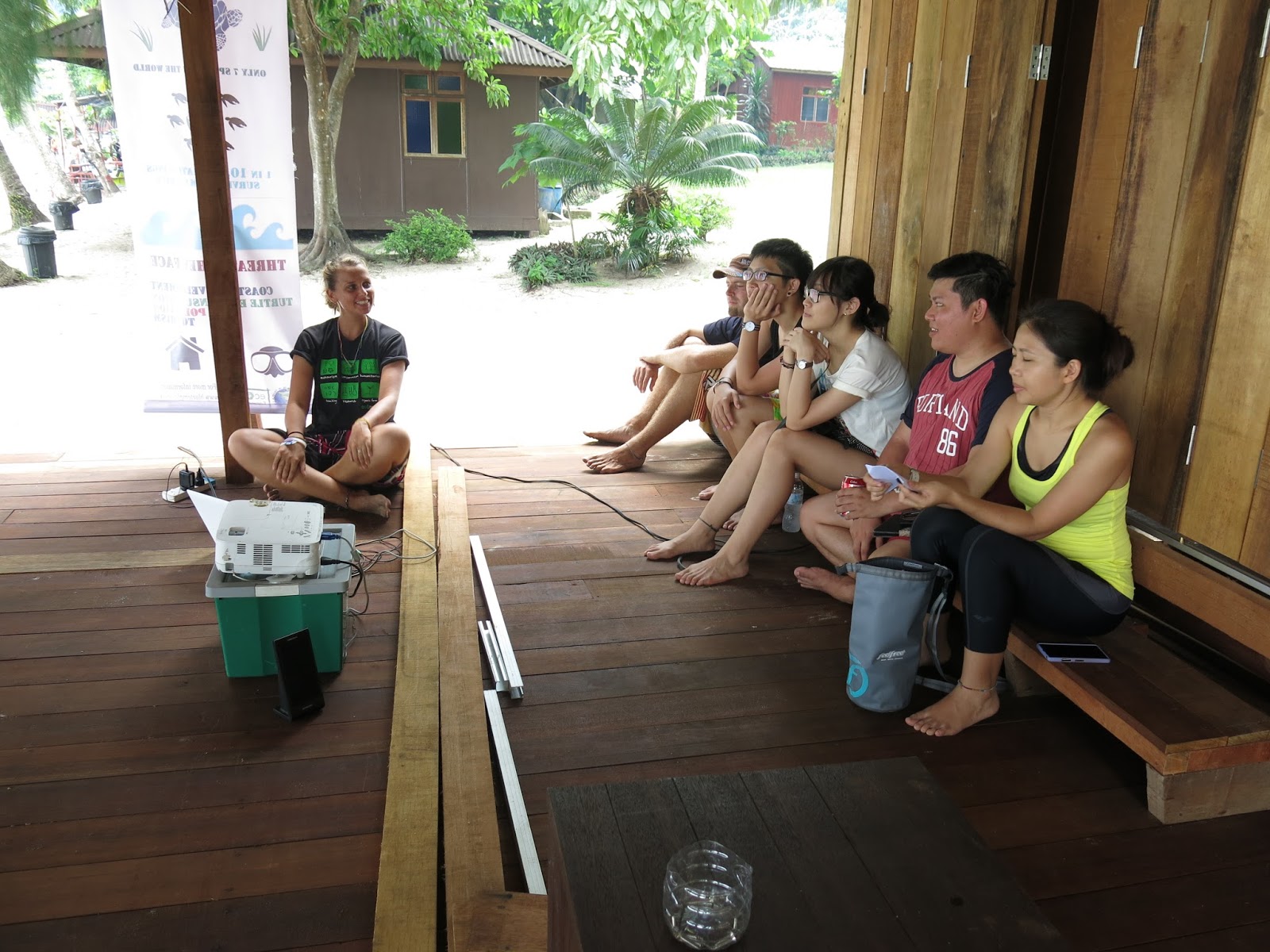
We arrived on Long Beach at 11:15(ish) and the team immediately split, with half heading over to Coral Bay for the first of the day’s presentations at Maya Chalet, whilst the remainder stayed at Long Beach to get the awareness Booth up and running.

Xuen, Shauna and Janneke all beautifully completed their presentations to a group of Malaysian students before heading back to Long Beach to set up for round 2 at D’Rock Gardens, where Xuen, Brian and Janneke were due to do their presentations for a modest group of interested tourists and staff.
Meanwhile, back at Long Beach, the team had instigated a 15 man tug of war in the shallows. I wasn’t there to witness it, but I hear they will write songs about Brian’s strength and ability to defeat the Long Beach Fifteen…or something. Much fun was had by all.


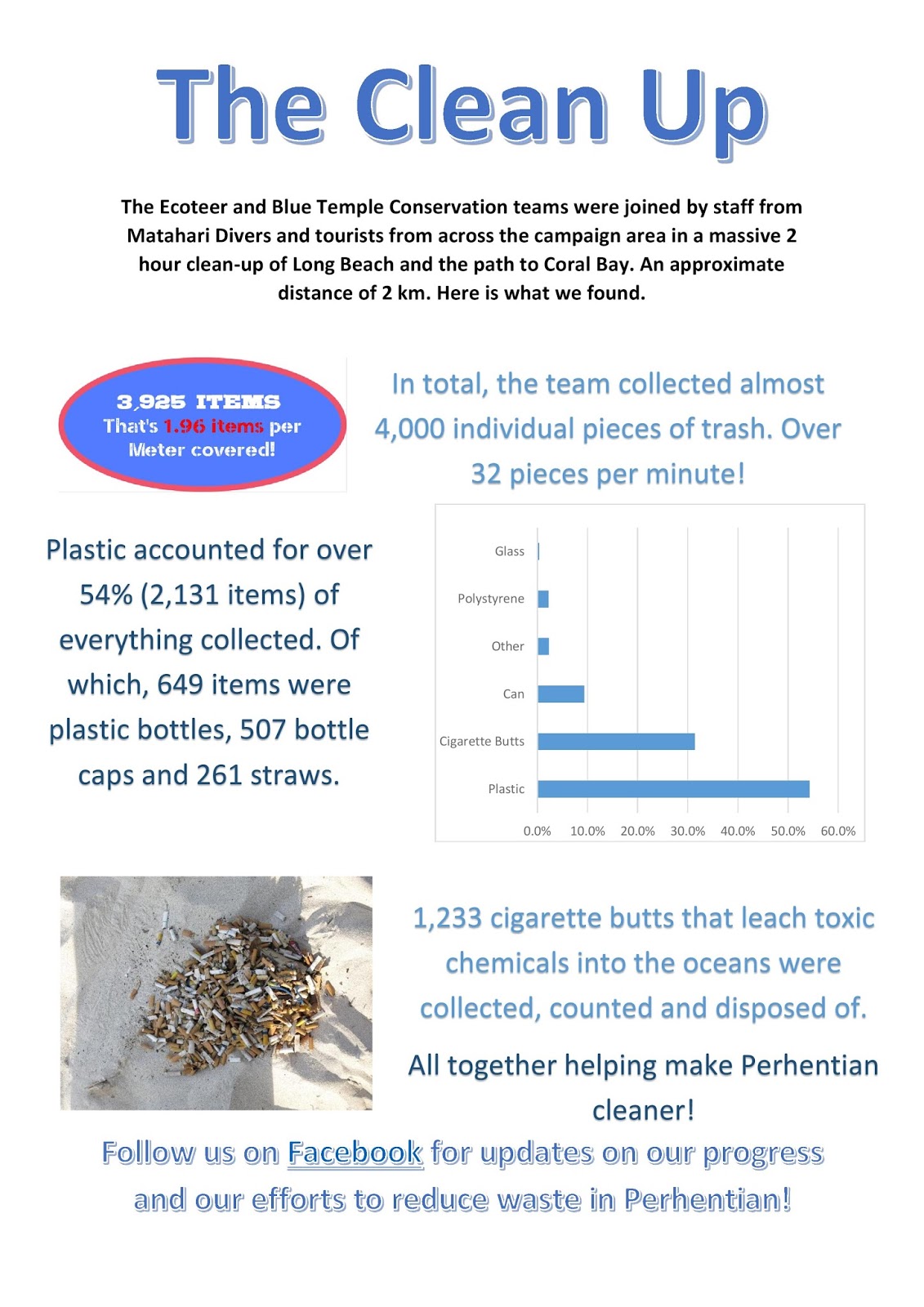
After the second round of presentations, the team united at Matahari Divers to commence an epic clean up. We were joined by a whole load of tourists and staff from the beach and quickly amassed a mighty quantity of trash. In only TWO HOURS, the team collected 3,925 individual pieces of rubbish, of which, a staggering 54% was plastic waste. Further evidence that our work and focus on plastic was important in our day! 


-----------------------------


What happened in the Clean up?


----------------------------

Whilst most of the team counted the trash, the rest visited Matahari Divers for round three of the presentations, this time Xuen and Neil led the talks to the collected divers, staff and clean-up crew.  

After a quick round up at Matahari, the whole team, united again packed up the awareness booth and presentations and walked the short walk to Ombak for the grand finale.


More presentations from Xuen, Neil, Brian and Shauna was followed by the closing Prize Draw, where all who had attended the presentations throughout the day were entered and drawn out, prizes were (seemingly) well received.


Hopefully, our efforts helped to raise awareness and maybe teach some people a little bit about our planet and it’s amazing ability to still survive after so many threats and impacts continue to strike out.

We really are blessed, our planet is so unique and fantastic that we often forget to celebrate its beauty, instead focusing on our desire for money, success or the negative impacts we are having. The oceans are huge, magnificent and so amazingly beautiful that it is hard not to love them.


If you want to do your part and protect the oceans, check out our Presentations at the links below, or visit World Oceans Day online and participate in their ‘Take the Better Bag’ challenge, and join the movement for Healthy Oceans.


Presentations