Showing posts with label ourocean. Show all posts

Tuesday, 5 April 2016

This is your home.


Imagine a lovely house, with 10 acres of land full of fruit and vegetables all growing freely. This is your home.


One day, without warning, a group of men walk in to your home and start to take away the bricks and wood from the ground floor of your house. The next day, a group of men arrive with big nets and start to catch all your fish in the lake. The next day, a different group of men cut down your woodlands and take all your vegetables.

You are left with a wasteland. With no fish in your lake it quickly succumbs to death, with no woodland you lose the wildlife necessary to pollinate your vegetables, and the wood for your fire and fuel. Without the ground floor walls of your house, it collapses. You are left with nothing.


How would you feel? You wouldn’t accept it. You wouldn’t let these people destroy your home, brick by brick. You would resist because it is your home. Just as we don’t let people walk into our homes and take our stuff.

So why do we let our governments and corporations do it to our planet. It is exactly the same. This planet is my, your, our home. Sure, a lot of what we do is necessary, we need to be warm in winter, we need to eat and we need shelter to live in. But how far are you willing to go to achieve comfort? Are you willing to destroy your home and everything you love for it?

When you have nothing left, you have to go to the men who took everything and pay them to give you your fish back so you can eat. You buy firewood for fuel so you can stay warm and you pay them to fix your house with the materials they took from you.

Public demand drives the destruction of your planet and your home. Take a stand against it and choose to protect the foundations of life on earth.

#FreeFromPlastic #OnePlanet #OurOcean


Wednesday, 18 November 2015

Microplastics: the invisible battle for ocean health


When we talk about marine debris, and in particular plastic, the first thing that comes to mind for many people, is plastic bags and bottles. We have, in our efforts to reduce plastic use, have focused a great deal on these larger, more visible items. But they are not the only, nor necessarily the biggest, threat to the marine environment when it comes to plastic. Microplastics, nearly invisible to the naked eye and estimated to number over 5 trillion pieces are now considered a major issue. Before we discuss microplastics however, let’s recap on some important facts about plastic.


  • In 2014, the amount of plastic created reached a record 314 million tons, a whopping 38% increase on the figures for 2014 (Plastic Oceans, 2015)
  • Estimations of plastic waste reaching the oceans is between 4.8 and 12.7 million metric tons annually (Shim and Thomposon 2015, Wang et al 2016)
  • Significant increases in the quantities of plastic in the North Pacific gyre and waters near the British Isles have been recorded between 1972 and 2010 (Wang et al 2016)
  • Plastic is resistant to biological degradation and instead fragments into smaller pieces, never truly disappearing (Shah et al 2008, Webb et al 2012)


Image courtesy of Flora and Fauna, 2013

Microplastics; what are they?

Any piece of plastic that measure below 5mm in size are considered a microplastic (Li et al 2015, Shim and Thomposon 2015, Wang et al 2016). They are the most common type of plastic found in the oceans (numerically), accounting for 92% of the total number of plastic particles (5.25 trillion) or 13% of the total weight (Shim and Thomposon 2015).

There are two types of microplastic; Primary and (you guessed it) Secondary. Primary microplastics (sometimes called microbeads) are those that were purposefully created by humans for a reason. Those reasons could be for your facial scrub or cleanser type things, sand-blasting equipment or shower-gel stuff. Secondary microplastics on the other hand, come into existence through the fragmentation of larger pieces of plastic (through human breakages and UV light deterioration) (Shim and Thomposon 2015, Wang et al 2016)

These tiny little pieces of plastic can make their way into our marine environment through many different ways. Secondary are commonly born in the ocean, as lost plastic waste endlessly floats in the ocean it fragments under the sun’s UV rays. Primary microplastics find their way into the ocean through long migratory journeys. Some will be a result of poorly managed waste disposal or clean ups, whilst others (the cleansers) are so small they can be washed down the plughole and slip through every type of water treatment, straight into the sea. You have undoubtedly heard the saying ‘all rivers flow to the sea’, and this is true (albeit with some rerouting), so any plastic that reaches the ocean, especially microplastics, are likely to find their way there one day.


The Big Blue

What is next for these baby microplastics as they set out to explore the massive expanse of the ocean? Will they float aimlessly for eternity, drifting wherever the currents take them? Or will they sink down to the depths and become one with the sediment? Or, maybe choose to join the food chain and find themselves eaten? There is a lot of research that discusses the behaviour of microplastics in the ocean, but simply put, they can be split into three categories; Physical, Chemical and Biological.

Physical behaviour relates to their movement in the water, this could be through migration with the currents, or accumulation in one of the massive mid-ocean gyres and even sinking and resting with the sediment at the bottom (Wang et al 2016). On its own, the physical behaviour of microplastics doesn’t really present any concerns or problems with regards to environmental or health issues. However when we couple it with chemical and biological behaviour, it is a different story.

Chemical behaviour relates, primarily, for plastic to undergo chemical changes or absorption of chemicals. As already mentioned, ‘natural’ fragmentation or degradation of plastic can happen, though slowly (even slower in the ocean). This processes, which takes place when plastic is exposed to the suns UV rays, are called ‘photo-oxidative’ and ‘thermos-oxidative’ reactions and result in the polymer (plastics) to change its properties (strength, colour and shape) (Wang et al 2016)

As plastics are broken down into smaller and smaller pieces, the available surface area for a process of absorption increases, which in turn increases the rate of absorption. Research has shown the plastics are veritable sponges when it comes to absorbing chemicals. Persistent Organic Pollutants (POPs) are contaminants that remain in the environment for prolonged periods and can remain a threat to humans and wildlife. Some examples of potential POPs that can be absorbed include Polycyclic Aromatic Hydrocarbons (PAHs), Polychlorinated Biphenyls (PCBs) and Dichlorodiphenylytrichloethane (DDT) (Wang et al 2016, Webb et al 2012).


  •  There are approximately 100 PAHs out there that are released from burning coal, gas, trash, tobacco, wood and other organic materials. Needless to say, some of these are anticipated to be carcinogens and have been linked to lung, liver and skin cancers (US National Library of Medicine 2015).
  • PCBs are man-made organics. They were banned in 1979, but before that were used in products of wide variety (plastics, floor finish, oil, transformers and cable insulation to name a few). During their manufactor and from poor waste management, PCBs leached into the environment and once there, they don’t break down much (persistent!). They have been shown to cause cancer as well as issues with immune, reproductive and nervous systems. So these are bad (EPA, 2013)
  • DDT is probably more commonly known and was used as a pesticide until it was banned in many countries. Whilst it hasn’t been shown to cause reproductive or birth defects in humans, tests on animals found some species were susceptible to harm. Whilst humans exposed to it have claimed nausea, confusion, headache, vomiting and fatigue all occur (National Pesticide Information Center, 1999)


The ability for plastic to absorb these harmful chemicals may at first seem like a good thing, a way to get them out of the environment. However, due to the size of the microplastics, and the ease marine species have in ingesting them (even down to plankton!) it is concerning for the health of our oceans and ourselves. Plastic has the ability to absorb and concentrate chemcials, but in our bodies they have the ability to release them and store them in our tissue and fats. If we consider bioaccumulation or biomagnification, we can understand that as we ascend the food chain, the amounts of chemicals increases (based on the number of little fish the bigger fish has to eat, it accumulates chemicals from each of them. This is one of the reasons science says to avoid eating a lot of fish (Tuna!) more than once a week. Mercury and other chemicals are found in higher and higher concentrations which can result in poor health, birth defects and cancers; both for ourselves and life in the oceans. Basically put, our use of plastic is poisoning ourselves and the oceans.


So, in conclusion, we know that macro and microplastics are commonplace in the ocean, increasing annually and migrating across huge expanses of ocean. We know that microplastics are really small and easily ingestible by even the smallest of marine life and that because of this, they are more and more commonly found within the food chain, up to the top predators. We know that microplastics can absorb harmful chemicals and metals, which they store and can then release into body tissues and fats. We know that these chemicals can accumulate within species, and magnify as they move up the trophic level (food web). We know that getting microplastics out of the ocean is a huge challenge that is almost impossible due to the size of nets we’d have to use to collect them catching literally everything.

We also know how we can change this. The choices we make on a daily basis can influence the levels of plastic reaching the oceans. Here is a small list of things you can do to make a difference:

  • Don't buy needlesslypackaged items; there is never a need for a plastic wrapped banana
  •  Always check your shower gels and facial scrubs for the ingredients; Polyethylene, Polypropylene, polyethylene terephthalate, polymethlyl methacrylate or nylon. It is all plastic!
  • Pick up plastic trash when you see it on the floor and dispose of properly
  •  Stop using ‘single-use’ plastic and start carrying reusable bags and bottles
  • Campaign to have microbeads banned in your local state (a la California)
  • Volunteer with local NGOs working against waste


Help us help you. Change the World.


The Blue Temple Team


Bibliography


Li J, Yang D, Li L, Jabeen K and Shi H (2015) Microplastics in commercial bivalves from China. Environmental Pollution. Elsevier Ltd 207: 190–195. Available at: http://linkinghub.elsevier.com/retrieve/pii/S0269749115300658.
Shah AA, Hasan F, Hameed A and Ahmed S (2008) Biological degradation of plastics: A comprehensive review. Biotechnology Advances 26(3): 246–265.
Shim WJ and Thomposon RC (2015) Microplastics in the Ocean. Archives of Environmental Contamination and Toxicology. Springer US 69(3): 265–268. Available at: "http://dx.doi.org/10.1007/s00244-015-0216-x.
Wang J, Tan Z, Peng J, Qiu Q and Li M (2016) The behaviors of microplastics in the marine environment. Marine Environmental Research. Elsevier Ltd 113: 7–17. Available at: http://linkinghub.elsevier.com/retrieve/pii/S0141113615300659.

Webb H, Arnott J, Crawford R and Ivanova E (2012) Plastic Degradation and Its Environmental Implications with Special Reference to Poly (ethylene terephthalate). Polymers 5(1): 1–18. Available at: http://ehis.ebscohost.com.ezproxy.unal.edu.co/ehost/pdfviewer/pdfviewer?sid=9bbfdbf9-ecd6-4a32-ba36-682939850b58@sessionmgr10&vid=13&hid=2\nhttp://www.mdpi.com/2073-4360/5/1/1/\nhttp://www.mdpi.com/2073-4360/5/1/1/pdf.

Friday, 14 August 2015

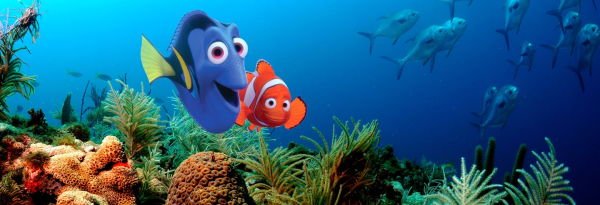
Why couldn’t the Clownfish buy a house?


 Because he didn’t have anemone!

-----

As part of our work in Perhentian, we have started to try and document and identify as many different species as we can, and we thought we’d start you all off with a volunteer favourite, Nemo!

You may or may not know that Nemo is a False Clown Fish (Amphiprion ocellaris), not your typical Clown Fish (Amphiprion percula). You may also be interested to know that Nemo and his ‘false clown fish’ daddy are just one of at least 20 different Anemonefish species. Because people love Anemonefish, and commonly mistake them all as Nemo or Clownfish, we thought we’d provide you a simple breakdown and summary of the different varieties we get here in Perhentian.

Anemonefish live in symbiosis with their anemones, that is, both the anemone and the fish give and receive something necessary to survive! The anemone protects the clownfish from potential predators and are provided a food source (algae and other creatures caught stung by anemone), whilst the clownfish has been suggested to do a wiggle dance that increases the oxygen flow through the anemone for a healthier lifestyle!

----

1.      
False Clown Fish (Amphiprion ocellaris)

The False Clown fish is orange, with three white bars and grow up to about 9cm. When they initially hatch they hang out near the surface, but quickly descend in search of an anemone in which to live. They are territorial and aggressive about it, and very protective of their domain and family, swimming out of the anemone to bite and harass would be attackers (even innocent by-standing divers just admiring their beauty!


Clark’s Anemone Fish (Amphriprion clarkii)

Clark’s Anemone fish are black to entirely orange with a pair of white or pale bluish bars. The tail is white or ellow with an abrupt boundary. Can grow to 12cm. Is omnivorous and will feed on zooplankton as well as algae. Helps to defend the anemone from would be attackers, such at Butterfly fish which may attempt to eat tentacles of anemone.


Pink Anemone Fish (Amphiprion perideraion)

The Pink Anemone fish is a common one in Perhentian, and found at most dive or snorkel sites. It is pink to orange with a narrow white head bar and a white dorsal stripe between the eyes going along the back. Commonly found with the Magnificent Anemone up to 20m depth. They can grow up to 10cm. As with other Anemone fish species, omnivorous species that feeds on both algae and zooplankton. Unlike the first two species mentioned, the Pink Anemone fish is much shier and hides within their anemone when divers approach. 


Red and Black Anemone Fish (Amphiprion polymnus)

The unique and excitingly named Red and Black Anemone fish is unsurprisingly reddish orange with varying amounts of black on the sides, and a white to pale bluish bar on the head, just being the eyes. Juveniles have 2-3 whitish blue bars. This one is sometimes called the Cinnamon clown fish and similar to the False Clown and Clark’s, can be aggressive towards invasive peoples. Only found in three anemone types; Bubble Tip, Leathery and Magnificent.


Saddleback Anemone Fish (Amphiprion polymnus)

Probably my favourite of the Perhentian Anemone fish, the Saddleback has varying amounts of black to dark brown and yellow-orange, with a white head bar and broad oft forward slanting mid-body bar. Usually found with Haddon’s Anemone on sandy bottoms. The first sighting was at Police Wreck, sitting off the wreck in the sand at about 21m depth, since then we have found a few locations around the islands. Their defence mechanism appears to be less aggressive than other species, they dance around in the water like madmen to distract you from the anemone (and baby fish). Crafty diversion strategy.


Tomato Anemone Fish (Amphiprion frenatus)

The aptly named Tomato Anemone fish tastes exactly like a tomato, or maybe just looks like one. Males are orange to red with a single white or pale bluish head bar, the males are considerably smaller than the females at only 6cm. Females grow to 14cm and are primarily black on the sides with a red snout breast and belly. Typically live with Bulb-tentacle anemone up to depths of 12m. They lay their eggs on a flat surface and both tend to them until they hatch (6-11 days).


Hopefully you have been inspired to further research fish and join us in Perhentian for some fun identification and diving times! Get in touch for more information!

Saturday, 4 July 2015

Corals; Adapting to Change


 Coral is a remarkable animal. Creators of some of the biggest and most valuable natural structures on Earth, they shape the environment around them to suit their needs, developing complex structures and harnessing support of algae to maximise their output.

Diving on a coral reef is an experience quite unlike any other. The variety of life surrounding you is truly astonishing, with as many as 3,000 different marine species living on one reef. Many of these species are cryptic, masters of disguise whilst others are brightly coloured to ward off predators. Whilst many divers visit the reef to witness these more cryptic or colourful fish, the corals themselves provide an opportunity to be rightly amazed. The variety of shapes, sizes and colours of just Genus is enough to confuse even the dedicated spotters, but their beauty lies in their complexity and simplicity combined. Within their structures live tiny polyps, little more than small stinging tentacles connected to a mouth and stomach.

It is fantastic to think that such tiny, simple creatures have created structures such as the Great Barrier Reef of Australia and are the foundations for the Coral Triangle, an ecosystem that is home to over 2,000 fish species as well as six out of the seven Sea Turtle species and upon which over 120 million people rely on in their daily lives.

Of course, as a race, we have over-exploited our oceans and planet to such an extent that corals are in constant threat of destruction and harm. From fish bombing in the Philippines and Malaysia to tourism and pollution in the Caribbean and South America and even climate change in our atmosphere, corals are in danger of harm from all angles, and that isn’t even mentioning the constant battles they face against each other on the reef!

Corals however, are not just going to roll over and give up. Once again, they continue to amaze and have begun to show remarkable signs of recovery and resilience against our many actions. Already in 2013, NOAA released a study that commented at present levels of CO2, Corals have the potential to evolve and adapt genetically to warming temperatures, potentially allowing longer survival until 2100. Of course, not all species are expected to make the necessary adaptations, and Darwin’s survival of the fittest will again be prominent, but that some corals may adapt is fantastic news.

More recently (this month!) NewScientist release an article stating that not only are some species able to adapt to warming temperatures, they are able to pass this trait genetically to their offspring, showing relatively rapid evolution in the face of threat and change. There is even evidence to suggest that by choosing the right algae (Zooxanthellae), adult corals can increase their heat resistance by 1.5degrees! They also found evidence that some corals in Palau, living in acidic waters have also shown no signs of detrimental change, though they are yet to identify the reason for this.

We, as a race, continue to bombard our environment with plastic, pollution, oil whilst simultaneously over-exploiting and over-extracting. Yet nature will continue to fight back, we may destroy 90% of it, but at some point, we will fall, balanced so precariously on a knife edge, and destroy ourselves in the process.


The evidence is building that coral is more resilient than we first thought which is awesome. Coral and nature, is amazingly fantastic, showing signs of evolution even in our short time on this Earth. It is wondrous and beautiful and we need just to open our eyes and marvel at it and maybe, just maybe, our actions would change, for the better. 

Sunday, 28 June 2015

Butts in our Sand

Since our World Oceans Day celebration on June 6th, we have focused on keeping a log of all our beach clean ups. You might have seen our fairly regular Facebook updates highlighting how much we found during each clean up. So far, the level of plastic found has been fairly consistent, averaging around the 40% - 45% mark.


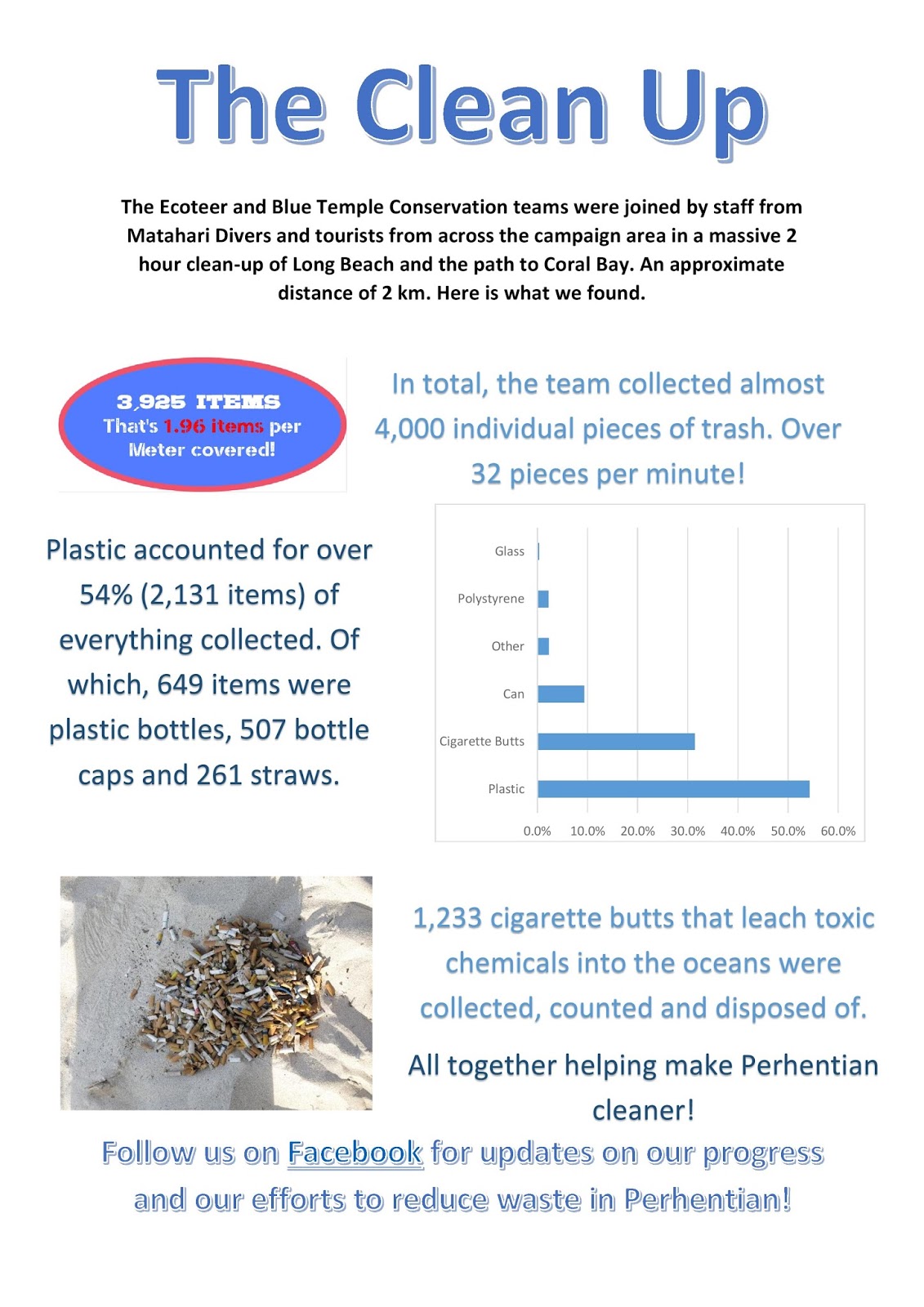
Of course, plastic has been in our sights recently due to the sheer volume of it, the constant concerns over plastic in the food chain and its ability to clog up the guts of many marine species. However, this is not why I write this post. Since we started collecting data, it has become painfully clear that the most common (and probably smallest) items we find are cigarette butts. In total, we have collected 2,440 butts over 7 beach clean ups. Of those, 569 were collected from the beach in the village, a 281m long beach that we have cleaned 4 times since 6th June. Teluk Keke, a popular snorkel tour stop and campsite was second with 404 butts collected in one morning, whilst Long Beach saw 1,233 butts collected in a 2 hour clean up.

A remarkable amount of cigarettes, but not a surprising amount, especially in beach areas. Sand makes a particularly good ash tray and quick for discarding cigarettes when finished. However, whilst people probably realise and understand the risks of smoking to themselves (And perhaps others around them), many will not realise the dangers of cigarettes can have on the environment.

This is not a new report, but the importance of it has been highlighted to us through the very high number of butts found on the islands. A study, conducted by Slaughter et al (2011) found that a cigarette butt in 1 litre of water leached enough toxins to kill fish living in that water. Of course, it could be argued that the amount of water in the sea is so huge that the amount of cigarettes required to make a difference is infinite, however, considering we collected 2,440 in about 10 hours, and the World Lung Foundation estimated 43 trillion cigarettes were smoked between 2002 and 2012, there is an almighty amount of water that could be damaged, even from cities, where rainwater and drainage run off can reach the seas.

It is difficult, and scary, to consider that one cigarette butt, improperly disposed of, could kill a fish. Remember, if you smoke; Stash it. Don’t Trash it.


Monday, 8 June 2015

Healthy Oceans, Healthy Planet; World Oceans Day Celebration


In the year 1992, the Earth Summit in Rio heralded a motion from the Government of Canada for the introduction of a day designed to celebrate and raise awareness for our oceans, 16 years later it was finally official and World Oceans Day was acknowledged by the UN and is celebrated annually on 8th June each year.

The theme for the year 2015-2016 has been chosen as ‘Healthy Oceans, Healthy Planet’, a theme dedicated to highlighting the importance our oceans have in our everyday lives, they are life-force that maintains balance to our planet.

We, amongst with millions of others focused on what actions we, as individuals and societies, can take to protect and safeguard the oceans for future generations of both humans and nature. We took a specific look at Plastic and its impacts on our beloved oceans.


Celebrating our Oceans in Pulau Perhentian
Some of you will already know that we are surrounded by stunning, tropical waters full of coral, fish and exotic species. So it should come as no surprise that we were keen to celebrate our oceans, and the importance they have with anyone and everyone we could get involved.

Due to the Department of Marine Parks event on the 7th and 8th June, we chose to set up our own event outside of the village, and head out to interact with tourists and resorts on the 6th June, instigating a three day Pulau Perhentian celebration!

Working together, Blue Temple Conservation and Ecoteer set out to provide both formal and Informal awareness, education, fun and games to tourists on Long Beach and Coral Bay, both on the small Island.

We arrived on Long Beach at 11:15(ish) and the team immediately split, with half heading over to Coral Bay for the first of the day’s presentations at Maya Chalet, whilst the remainder stayed at Long Beach to get the awareness Booth up and running.

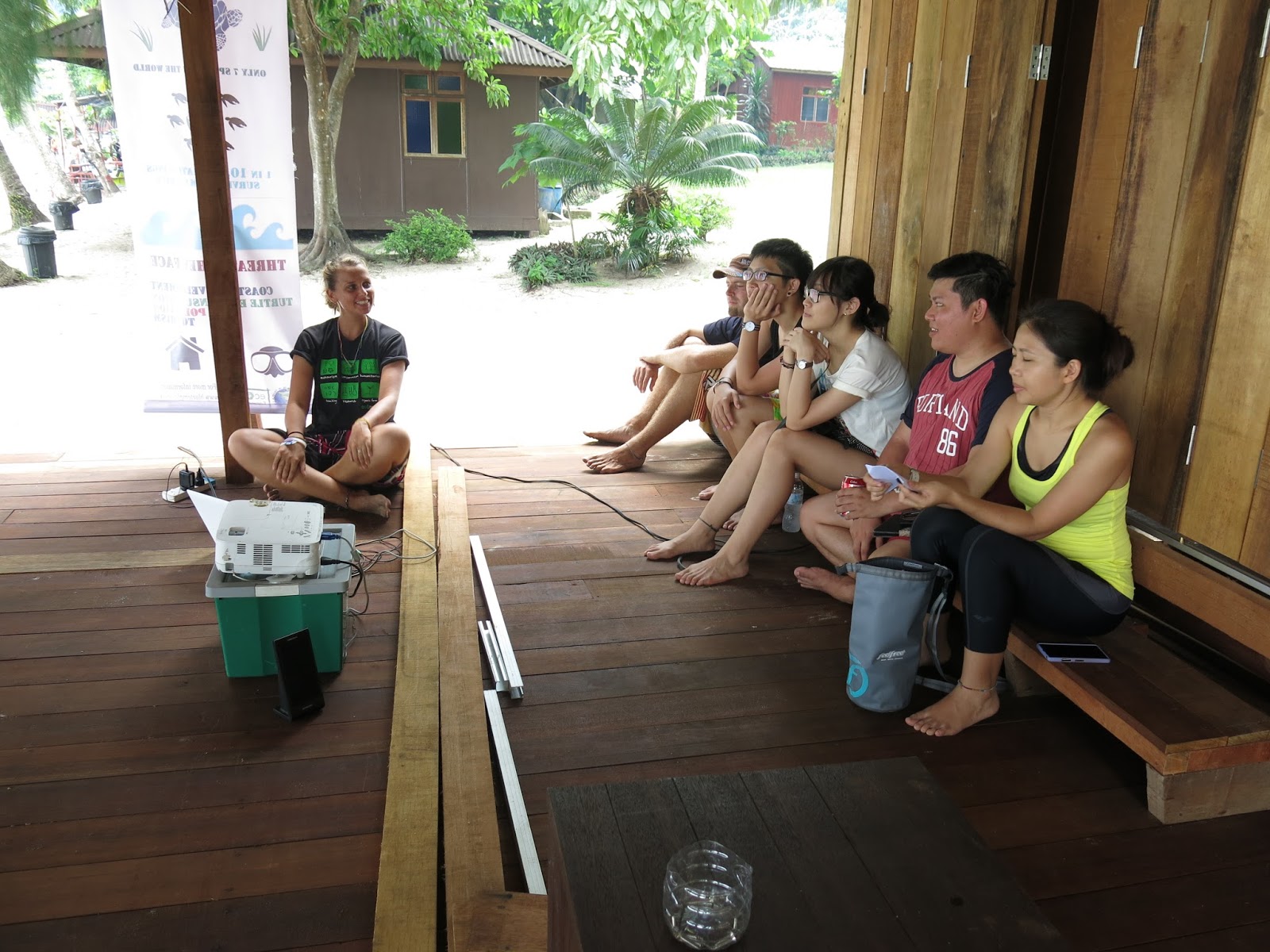
Xuen, Shauna and Janneke all beautifully completed their presentations to a group of Malaysian students before heading back to Long Beach to set up for round 2 at D’Rock Gardens, where Xuen, Brian and Janneke were due to do their presentations for a modest group of interested tourists and staff.
Meanwhile, back at Long Beach, the team had instigated a 15 man tug of war in the shallows. I wasn’t there to witness it, but I hear they will write songs about Brian’s strength and ability to defeat the Long Beach Fifteen…or something. Much fun was had by all.


After the second round of presentations, the team united at Matahari Divers to commence an epic clean up. We were joined by a whole load of tourists and staff from the beach and quickly amassed a mighty quantity of trash. In only TWO HOURS, the team collected 3,925 individual pieces of rubbish, of which, a staggering 54% was plastic waste. Further evidence that our work and focus on plastic was important in our day! 


-----------------------------


What happened in the Clean up?


----------------------------

Whilst most of the team counted the trash, the rest visited Matahari Divers for round three of the presentations, this time Xuen and Neil led the talks to the collected divers, staff and clean-up crew.  

After a quick round up at Matahari, the whole team, united again packed up the awareness booth and presentations and walked the short walk to Ombak for the grand finale.


More presentations from Xuen, Neil, Brian and Shauna was followed by the closing Prize Draw, where all who had attended the presentations throughout the day were entered and drawn out, prizes were (seemingly) well received.


Hopefully, our efforts helped to raise awareness and maybe teach some people a little bit about our planet and it’s amazing ability to still survive after so many threats and impacts continue to strike out.

We really are blessed, our planet is so unique and fantastic that we often forget to celebrate its beauty, instead focusing on our desire for money, success or the negative impacts we are having. The oceans are huge, magnificent and so amazingly beautiful that it is hard not to love them.


If you want to do your part and protect the oceans, check out our Presentations at the links below, or visit World Oceans Day online and participate in their ‘Take the Better Bag’ challenge, and join the movement for Healthy Oceans.


Presentations