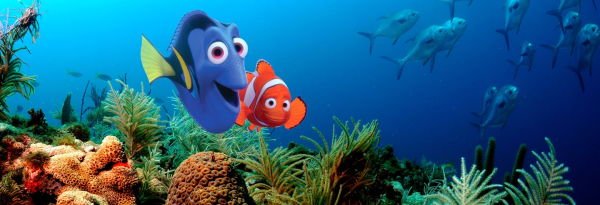
Because he didn’t have anemone!
-----
As part of our work in Perhentian, we have started to try and
document and identify as many different species as we can, and we thought we’d
start you all off with a volunteer favourite, Nemo!
You may or may not know that Nemo is a False Clown Fish
(Amphiprion ocellaris), not your
typical Clown Fish (Amphiprion percula). You
may also be interested to know that Nemo and his ‘false clown fish’ daddy are
just one of at least 20 different Anemonefish species. Because people love
Anemonefish, and commonly mistake them all as Nemo or Clownfish, we thought we’d
provide you a simple breakdown and summary of the different varieties we get
here in Perhentian.
Anemonefish
live in symbiosis with their anemones, that is, both the anemone and the fish
give and receive something necessary to survive! The anemone protects the
clownfish from potential predators and are provided a food source (algae and
other creatures caught stung by anemone), whilst the clownfish has been
suggested to do a wiggle dance that increases the oxygen flow through the
anemone for a healthier lifestyle!
----
1.

False Clown Fish (Amphiprion ocellaris)

Clark’s
Anemone Fish (Amphriprion clarkii)


 Probably
my favourite of the Perhentian Anemone fish, the Saddleback has varying amounts
of black to dark brown and yellow-orange, with a white head bar and broad oft
forward slanting mid-body bar. Usually found with Haddon’s Anemone on sandy
bottoms. The first sighting was at Police Wreck, sitting off the wreck in the
sand at about 21m depth, since then we have found a few locations around the
islands. Their defence mechanism appears to be less aggressive than other
species, they dance around in the water like madmen to distract you from the
anemone (and baby fish). Crafty diversion strategy.
Probably
my favourite of the Perhentian Anemone fish, the Saddleback has varying amounts
of black to dark brown and yellow-orange, with a white head bar and broad oft
forward slanting mid-body bar. Usually found with Haddon’s Anemone on sandy
bottoms. The first sighting was at Police Wreck, sitting off the wreck in the
sand at about 21m depth, since then we have found a few locations around the
islands. Their defence mechanism appears to be less aggressive than other
species, they dance around in the water like madmen to distract you from the
anemone (and baby fish). Crafty diversion strategy.
 Tomato
Anemone Fish (Amphiprion frenatus)
Tomato
Anemone Fish (Amphiprion frenatus)
Clark’s Anemone fish are black to entirely orange with a pair
of white or pale bluish bars. The tail is white or ellow with an abrupt
boundary. Can grow to 12cm. Is omnivorous and will feed on zooplankton as well
as algae. Helps to defend the anemone from would be attackers, such at
Butterfly fish which may attempt to eat tentacles of anemone.
Pink Anemone Fish (Amphiprion
perideraion)

The Pink Anemone fish is a common one in Perhentian, and
found at most dive or snorkel sites. It is pink to orange with a narrow white head
bar and a white dorsal stripe between the eyes going along the back. Commonly
found with the Magnificent Anemone up to 20m depth. They can grow up to 10cm.
As with other Anemone fish species, omnivorous species that feeds on both algae
and zooplankton. Unlike the first two species mentioned, the Pink Anemone fish
is much shier and hides within their anemone when divers approach.
Red and Black Anemone Fish (Amphiprion
polymnus)
The unique and excitingly named Red and Black Anemone fish is unsurprisingly reddish orange with varying amounts of black on
the sides, and a white to pale bluish bar on the head, just being the eyes.
Juveniles have 2-3 whitish blue bars. This one is sometimes called the Cinnamon
clown fish and similar to the False Clown and Clark’s, can be aggressive
towards invasive peoples. Only found in three anemone types; Bubble Tip,
Leathery and Magnificent.

Saddleback Anemone Fish (Amphiprion
polymnus)
 Probably
my favourite of the Perhentian Anemone fish, the Saddleback has varying amounts
of black to dark brown and yellow-orange, with a white head bar and broad oft
forward slanting mid-body bar. Usually found with Haddon’s Anemone on sandy
bottoms. The first sighting was at Police Wreck, sitting off the wreck in the
sand at about 21m depth, since then we have found a few locations around the
islands. Their defence mechanism appears to be less aggressive than other
species, they dance around in the water like madmen to distract you from the
anemone (and baby fish). Crafty diversion strategy.
Probably
my favourite of the Perhentian Anemone fish, the Saddleback has varying amounts
of black to dark brown and yellow-orange, with a white head bar and broad oft
forward slanting mid-body bar. Usually found with Haddon’s Anemone on sandy
bottoms. The first sighting was at Police Wreck, sitting off the wreck in the
sand at about 21m depth, since then we have found a few locations around the
islands. Their defence mechanism appears to be less aggressive than other
species, they dance around in the water like madmen to distract you from the
anemone (and baby fish). Crafty diversion strategy. Tomato
Anemone Fish (Amphiprion frenatus)
Tomato
Anemone Fish (Amphiprion frenatus)
The aptly named Tomato Anemone fish tastes exactly like a
tomato, or maybe just looks like one. Males are orange to red with a single
white or pale bluish head bar, the males are considerably smaller than the
females at only 6cm. Females grow to 14cm and are primarily black on the sides
with a red snout breast and belly. Typically live with Bulb-tentacle anemone up
to depths of 12m. They lay their eggs on a flat surface and both tend to them
until they hatch (6-11 days).
Hopefully you have been inspired to further research fish and
join us in Perhentian for some fun identification and diving times! Get in touch for more information!


