Saturday, 4 July 2015

Corals; Adapting to Change


 Coral is a remarkable animal. Creators of some of the biggest and most valuable natural structures on Earth, they shape the environment around them to suit their needs, developing complex structures and harnessing support of algae to maximise their output.

Diving on a coral reef is an experience quite unlike any other. The variety of life surrounding you is truly astonishing, with as many as 3,000 different marine species living on one reef. Many of these species are cryptic, masters of disguise whilst others are brightly coloured to ward off predators. Whilst many divers visit the reef to witness these more cryptic or colourful fish, the corals themselves provide an opportunity to be rightly amazed. The variety of shapes, sizes and colours of just Genus is enough to confuse even the dedicated spotters, but their beauty lies in their complexity and simplicity combined. Within their structures live tiny polyps, little more than small stinging tentacles connected to a mouth and stomach.

It is fantastic to think that such tiny, simple creatures have created structures such as the Great Barrier Reef of Australia and are the foundations for the Coral Triangle, an ecosystem that is home to over 2,000 fish species as well as six out of the seven Sea Turtle species and upon which over 120 million people rely on in their daily lives.

Of course, as a race, we have over-exploited our oceans and planet to such an extent that corals are in constant threat of destruction and harm. From fish bombing in the Philippines and Malaysia to tourism and pollution in the Caribbean and South America and even climate change in our atmosphere, corals are in danger of harm from all angles, and that isn’t even mentioning the constant battles they face against each other on the reef!

Corals however, are not just going to roll over and give up. Once again, they continue to amaze and have begun to show remarkable signs of recovery and resilience against our many actions. Already in 2013, NOAA released a study that commented at present levels of CO2, Corals have the potential to evolve and adapt genetically to warming temperatures, potentially allowing longer survival until 2100. Of course, not all species are expected to make the necessary adaptations, and Darwin’s survival of the fittest will again be prominent, but that some corals may adapt is fantastic news.

More recently (this month!) NewScientist release an article stating that not only are some species able to adapt to warming temperatures, they are able to pass this trait genetically to their offspring, showing relatively rapid evolution in the face of threat and change. There is even evidence to suggest that by choosing the right algae (Zooxanthellae), adult corals can increase their heat resistance by 1.5degrees! They also found evidence that some corals in Palau, living in acidic waters have also shown no signs of detrimental change, though they are yet to identify the reason for this.

We, as a race, continue to bombard our environment with plastic, pollution, oil whilst simultaneously over-exploiting and over-extracting. Yet nature will continue to fight back, we may destroy 90% of it, but at some point, we will fall, balanced so precariously on a knife edge, and destroy ourselves in the process.


The evidence is building that coral is more resilient than we first thought which is awesome. Coral and nature, is amazingly fantastic, showing signs of evolution even in our short time on this Earth. It is wondrous and beautiful and we need just to open our eyes and marvel at it and maybe, just maybe, our actions would change, for the better. 

Sunday, 28 June 2015

Butts in our Sand

Since our World Oceans Day celebration on June 6th, we have focused on keeping a log of all our beach clean ups. You might have seen our fairly regular Facebook updates highlighting how much we found during each clean up. So far, the level of plastic found has been fairly consistent, averaging around the 40% - 45% mark.


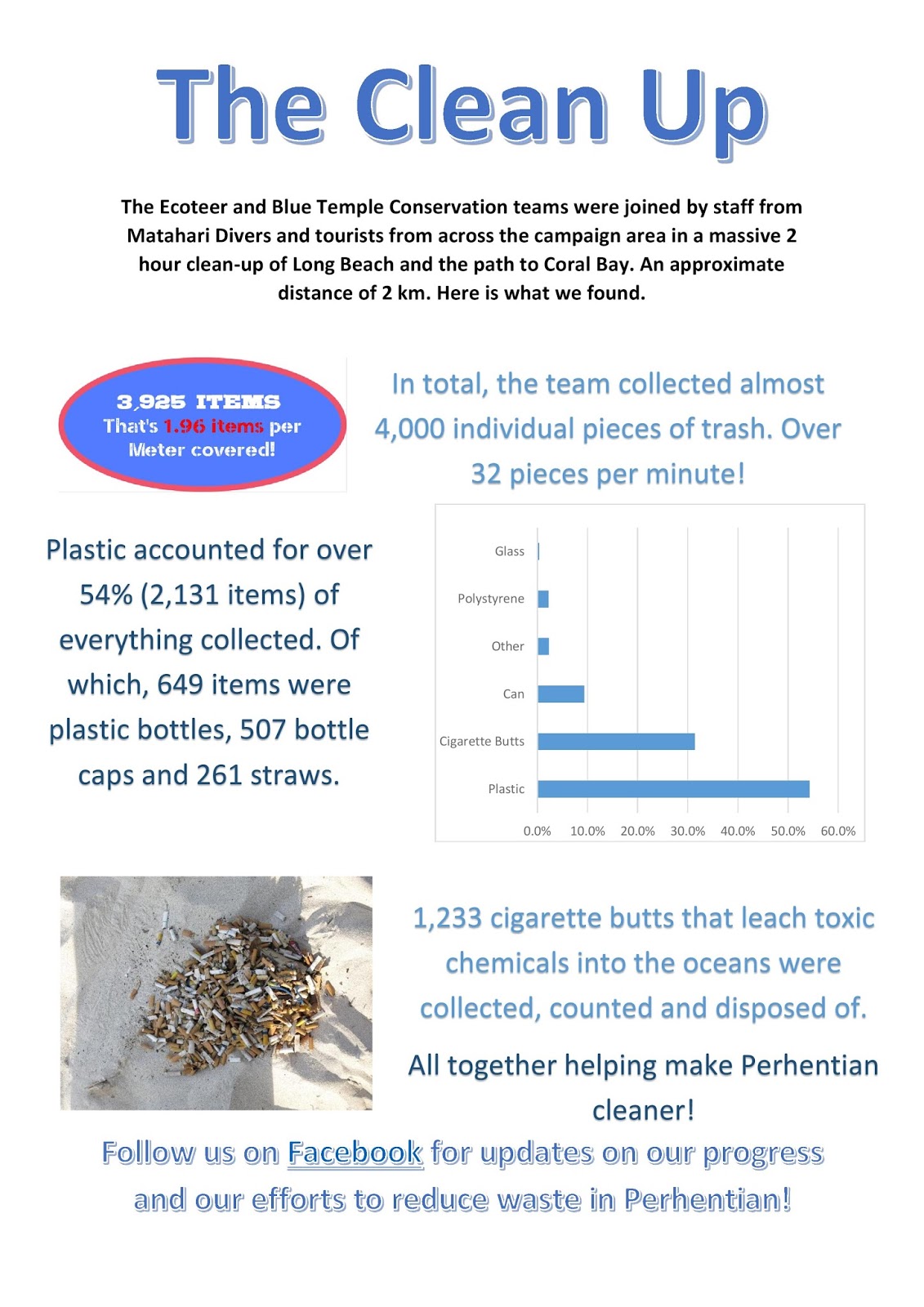
Of course, plastic has been in our sights recently due to the sheer volume of it, the constant concerns over plastic in the food chain and its ability to clog up the guts of many marine species. However, this is not why I write this post. Since we started collecting data, it has become painfully clear that the most common (and probably smallest) items we find are cigarette butts. In total, we have collected 2,440 butts over 7 beach clean ups. Of those, 569 were collected from the beach in the village, a 281m long beach that we have cleaned 4 times since 6th June. Teluk Keke, a popular snorkel tour stop and campsite was second with 404 butts collected in one morning, whilst Long Beach saw 1,233 butts collected in a 2 hour clean up.

A remarkable amount of cigarettes, but not a surprising amount, especially in beach areas. Sand makes a particularly good ash tray and quick for discarding cigarettes when finished. However, whilst people probably realise and understand the risks of smoking to themselves (And perhaps others around them), many will not realise the dangers of cigarettes can have on the environment.

This is not a new report, but the importance of it has been highlighted to us through the very high number of butts found on the islands. A study, conducted by Slaughter et al (2011) found that a cigarette butt in 1 litre of water leached enough toxins to kill fish living in that water. Of course, it could be argued that the amount of water in the sea is so huge that the amount of cigarettes required to make a difference is infinite, however, considering we collected 2,440 in about 10 hours, and the World Lung Foundation estimated 43 trillion cigarettes were smoked between 2002 and 2012, there is an almighty amount of water that could be damaged, even from cities, where rainwater and drainage run off can reach the seas.

It is difficult, and scary, to consider that one cigarette butt, improperly disposed of, could kill a fish. Remember, if you smoke; Stash it. Don’t Trash it.


Monday, 8 June 2015

Healthy Oceans, Healthy Planet; World Oceans Day Celebration


In the year 1992, the Earth Summit in Rio heralded a motion from the Government of Canada for the introduction of a day designed to celebrate and raise awareness for our oceans, 16 years later it was finally official and World Oceans Day was acknowledged by the UN and is celebrated annually on 8th June each year.

The theme for the year 2015-2016 has been chosen as ‘Healthy Oceans, Healthy Planet’, a theme dedicated to highlighting the importance our oceans have in our everyday lives, they are life-force that maintains balance to our planet.

We, amongst with millions of others focused on what actions we, as individuals and societies, can take to protect and safeguard the oceans for future generations of both humans and nature. We took a specific look at Plastic and its impacts on our beloved oceans.


Celebrating our Oceans in Pulau Perhentian
Some of you will already know that we are surrounded by stunning, tropical waters full of coral, fish and exotic species. So it should come as no surprise that we were keen to celebrate our oceans, and the importance they have with anyone and everyone we could get involved.

Due to the Department of Marine Parks event on the 7th and 8th June, we chose to set up our own event outside of the village, and head out to interact with tourists and resorts on the 6th June, instigating a three day Pulau Perhentian celebration!

Working together, Blue Temple Conservation and Ecoteer set out to provide both formal and Informal awareness, education, fun and games to tourists on Long Beach and Coral Bay, both on the small Island.

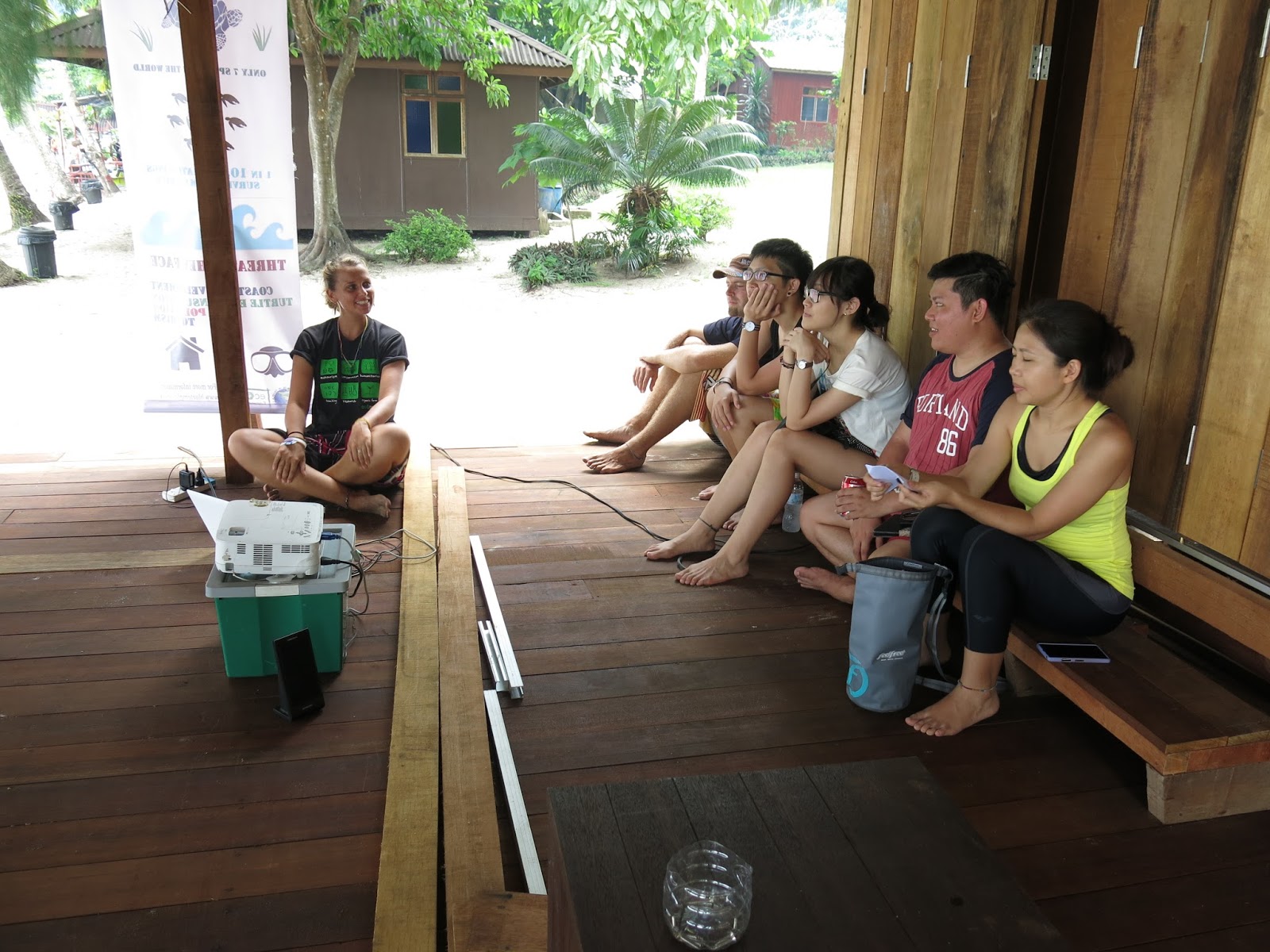
We arrived on Long Beach at 11:15(ish) and the team immediately split, with half heading over to Coral Bay for the first of the day’s presentations at Maya Chalet, whilst the remainder stayed at Long Beach to get the awareness Booth up and running.

Xuen, Shauna and Janneke all beautifully completed their presentations to a group of Malaysian students before heading back to Long Beach to set up for round 2 at D’Rock Gardens, where Xuen, Brian and Janneke were due to do their presentations for a modest group of interested tourists and staff.
Meanwhile, back at Long Beach, the team had instigated a 15 man tug of war in the shallows. I wasn’t there to witness it, but I hear they will write songs about Brian’s strength and ability to defeat the Long Beach Fifteen…or something. Much fun was had by all.


After the second round of presentations, the team united at Matahari Divers to commence an epic clean up. We were joined by a whole load of tourists and staff from the beach and quickly amassed a mighty quantity of trash. In only TWO HOURS, the team collected 3,925 individual pieces of rubbish, of which, a staggering 54% was plastic waste. Further evidence that our work and focus on plastic was important in our day! 


-----------------------------


What happened in the Clean up?


----------------------------

Whilst most of the team counted the trash, the rest visited Matahari Divers for round three of the presentations, this time Xuen and Neil led the talks to the collected divers, staff and clean-up crew.  

After a quick round up at Matahari, the whole team, united again packed up the awareness booth and presentations and walked the short walk to Ombak for the grand finale.


More presentations from Xuen, Neil, Brian and Shauna was followed by the closing Prize Draw, where all who had attended the presentations throughout the day were entered and drawn out, prizes were (seemingly) well received.


Hopefully, our efforts helped to raise awareness and maybe teach some people a little bit about our planet and it’s amazing ability to still survive after so many threats and impacts continue to strike out.

We really are blessed, our planet is so unique and fantastic that we often forget to celebrate its beauty, instead focusing on our desire for money, success or the negative impacts we are having. The oceans are huge, magnificent and so amazingly beautiful that it is hard not to love them.


If you want to do your part and protect the oceans, check out our Presentations at the links below, or visit World Oceans Day online and participate in their ‘Take the Better Bag’ challenge, and join the movement for Healthy Oceans.


Presentations


Friday, 22 May 2015

International Day for Biological Diversity


Today, we celebrate International Day for Biological Diversity, a bit of a mouthful, but an important day to reflect on our environments, ecosystems and biological surroundings and to understand their importance. As I write this, I sit on a tropical island, surrounded by rainforests, white sandy beaches and stunning coral reef environments. So it is perhaps very easy for me to sit and talk about the importance and value of these systems and their biological diversity, but if you spend a few minutes to think about the environment you live in, I am sure you will find equally important links.

2015’s theme is ‘Biodiversity for Sustainable Development’. When people think of biodiversity and development together, they usually see it as development destroying biodiversity (the eco-warrior view) or biodiversity preventing development (the corporation view). In reality, there is no reason why the two things cannot work together, technology has advanced to a stage where there is no reason we can’t accommodate biodiversity in our lives and development; Sustainable Development.

To understand what sustainable development is, we first need to know what sustainable means. The most commonly used definition is taken from ‘Our Common Future’ (1987) states:

"Sustainable development is development that meets the needs of the present without compromising the ability of future generations to meet their own needs”

Within this, they consider two key notions, firstly the notion of ‘needs’, particularly those of the world’s poorest, to which key consideration should be given. Secondly the notion of limitations felt by technology and society on the ability for the environment to meet said needs.


As I already said, it is very easy for me to consider biological diversity where I am due to the very obvious importance of the ecosystems and development for the local community. There are inherent links between the local community and the biological diversity of the islands. The relationships between development, society and the environment are complicated and difficult, which just further highlights the importance of considering sustainable development.


So this highly scientific and complicated looking image clearly took hours of research and time to develop…Ok fine, it didn't, but it can quickly highlight the relationships and importance of sustainable development within the Perhentian Islands.

The community rely, predominantly, on tourism to remain economically sustainable. Tourism, in turn relies on a number of factors, resorts, rainforests coral reefs and turtles. A simple questionnaire we conducted last year showed that 60% (n 274) of tourists wanted to see a turtle, whilst 80% said they had already, or planned to go on a snorkel tour during their stay. Both of these aspects highlight the importance of biological diversity through the importance of the presence of coral reefs and turtles for sustainable development. In order to develop the islands, there must always be a consideration for these aspects, including the threats (Sedimentation, over fishing, waste management) that come hand in hand with development and deforestation.

Why is biological diversity important in a coral reef you ask? Let’s look at the well-researched and complicated diagram below to help us understand…


The image that was carefully put together above highlights the varied intricacies found within an ecosystem. This is a highly simplified diagram, so please do not take it as absolute. We can see that Fish are involved in many interactions, which is because this category includes numerous species with varying behaviours! 

Parrotfish, Butterflyfish, Damsel fish and other grazers can often be found eating algae from the reef, without them, the algae would be given too much of a free reign and could over grow the reef, smothering corals (not feeding on, just smothering), a similar scenario could exist if nutrient levels were to increase excessively, such as an area where no proper sewerage were present and waste flowed or leeched directly into the sea. Likewise, excessive removal of predator species at the top of the food chain, can result in explosions in the fish category, meaning reduced levels of invertebrates and algae.

Ecosystems are carefully balanced and naturally fluctuate annually and seasonally, but in areas where development is occurring, like Perhentian, it is vital that it is competed sustainably, considering the long term implications and careful management of the biological diversity in-line with the societal and economic success. 


Tuesday, 21 April 2015

Earth Day 2015; It's our turn to lead

Author; David Richards, Images; Neil Hinds

The world’s first official Earth Day was held on the 22nd April 1970, a day widely credited as the launch of the modern environmental movement. Fast-forward forty-five years, and you begin to realise just how significant this day was. This year, it is expected that over a billion people will participate in Earth Day activities, which makes Earth Day 2015 one of the largest civic observances in the world.

As part of this year’s celebration, the Earth Day Network are spreading the message, ‘It’s our turn to lead’. With this message in mind, Blue Temple Conservation decided to explore our impact on the planet and assess whether we could implement any changes to our lifestyle here in Pulau Perhentian. The first step in this exploration was to calculate our ecological footprint. Each of the ecological footprint calculators we used assessed aspects of our lifestyle including our diet (namely how much food we consumed and where it was produced), travel patterns (primary means of transport and overseas travel), home (the number of people in our household and our use of energy efficient lighting and appliances) and consumption (our demand for new items, such as clothing, furniture and 'stuff' in general). It's important to note that many of the questions featured in the ecological footprint calculators available online were not particularly relevant to us. For example, the primary means of transport that we use here in the islands (boats) was rarely listed or assessed.


Travel is our biggest source of Carbon, followed
by food and secondary living items!

Though the results varied depending on the particular calculator used and the methodology adopted, one thing remained clear. If everyone in the world were to adopt our current lifestyle, we would require a lot more than one planet to provide the resources that we use and to absorb the waste that we produce. To be completely honest, this came as no real surprise to us as long-distance air travel is an unavoidable aspect of our lives. We are located halfway across the world and a single return flight from London's Heathrow Airport to Kuala Lumpur contributes approximately 1.69 metric tonnes of carbon dioxide emissions per person. To put this in perspective, based on 2010 World Bank data, the average global citizen emits 4.9 metric tonnes of CO2 annually.

We may be unable to commit to changing our location, but we are very willing to commit to other changes that may help mitigate our impact on the planet. The first change that we are willing to commit to, and our first 'act of green' as part of Earth Day 2015, is to eliminate meat (including seafood) from our diets on both Mondays and Fridays. Did you know that one calorie of meat requires more than twenty times the amount of energy as one plant calorie? By reducing our consumption of meat, we can contribute to a reduction in our greenhouse gas emissions, a reduction in our dependence on fossil fuels and a reduction in water usage. This relatively minor change to our lifestyles may also have a positive impact on our health with the benefits of reducing meat consumption becoming more evident and scientifically-proven.

Our second commitment as part of Earth Day 2015 (which was inspired by our recent visitors from Reefcheck Malaysia, Sue and Alvin) is to discontinue using plastic bags. Estimates suggest that each year between 500 billion and 1 trillion plastic bags are consumed, amounting to approximately one million plastic bags per minute. Further, on average, a person will use a plastic bag for only 12 minutes. In our opinion, plastic bags are a perfect example of the 'single-use' mentality, which provides the foundations for the problematic consumption patterns plaguing societies in both the developed and developing world. Together with the image of all the plastic we collect on our regular beach cleanups, these statistics should provide all the encouragement we need to make this commitment. The only reason we currently accept plastic bags from the stores throughout the village is convenience. By instigating a relatively minor behavioural change in our lives (namely taking a reusable bag or back pack with us whenever we go shopping), we will be able to set a positive example within the community here in Pulau Perhentian and also, reduce our contribution to the amount of plastic waste currently crippling the world's natural environment.

Our third and final commitment as part of Earth Day 2015 is to reduce the amount of waste we produce. Essentially, this is an extension and expansion of our second commitment and, in our opinion, presents our biggest challenge. This being said, we have already taken one big step in the right direction by installing an aerobic compost system for our organic waste matter, which consists primarily of fruit and vegetable scraps, egg shells and tea bags. In addition to this, we will also be making a conscious effort to reduce the amount of water, cleaning products, plastic bottles and non-recyclable packaging we use in our day-to-day lives. To achieve significant reductions, we will need to be thinking about this commitment each and every day, which is why we will be creating and introducing signs throughout our house to remind us of our commitment and provide the encouragement necessary to achieve change.

Our pledges for Earth Day 2015


Do you remember the message attached to Earth Day 2015...? 'It's our turn to lead'. As the state of the environment deteriorates, it becomes easier and easier to accept defeat and adopt a pessimistic attitude, specifically the 'what difference can one person make' mentality. However, Blue Temple Conservation refuses to lose sight of the impact (however small that may be) that individual acts can have on reducing carbon dioxide emissions and supporting the future sustainability of contemporary society. Since the introduction of Earth Day, more than one billion 'Acts of Green' have been pledged by individuals and businesses making it the world's largest environmental service campaign and providing ample evidence that we aren't the only ones willing to make a change to our lives. Collectively, our acts of green, our commitments, can make a difference.


Further Information:

Ecological FootprintCalculator powered by Global Footprint Calculator


The largest environmental service campaign in the world – inspires and rewards simple individual acts and larger organizational initiatives that further the goal of measurably reducing carbon emissions and supporting sustainability. 


Saturday, 18 April 2015

A Survey to Remember: Reef Check

 Since our last volunteer, Rachel, finished her time with us, we have been relatively quiet, keeping ourselves busy painting signs for a local food store, setting up our new compost bin and managing our garden, with the occasional dive thrown in for training purposes.


Sabi's planted goodies
Dave adding finishing touches to sign
Neil's compost bin


This week however, we were joined by Sue and Alvin of ReefCheck Malaysia, who were visiting the islands to conduct their annual Reef Check surveys. If you followed our research last year, you will know that our methods are adapted from the original Reef Check methodology, so it is all very relevant, and Reef Check visit the islands once a year to monitor the health of 10 coral reef sites.


Alvin (left) and Sue (right) at the end of our Batu Layar survey

Last year, both Sabina and I (Neil) were lucky enough to be trained, along with Seh Ling from Ecoteer, as Reef Check Eco-Divers. This year, we (Blue Temple) offered to collaborate with Reef Check on their surveys, providing accommodation and assistance (and tanks, which they refused!) to work together to collect their all-important data.

So, it came to pass that on the morning of Tuesday 14th April 2015, Sue and Alvin arrived, via a night bus at Perhentian, ready to get started. The schedule was quite straight forwards, two days of 3 dives, conducting 6 of the 10 surveys required, with the final day being completed with the Marine Park staff, except that the Marine Parks had doubled booked, opening the door for us to assist with all 10 surveys (Awesome!)

Sabi, Alvin and Seh Ling doing Invert and Substrate surveys

Alvin getting up close and personal with substrate

Invertebrate Team - Sabi and Seh Ling

Neil seeking Inverts

Sue studying substrate


I won’t bore you with all the details, but let’s just say that with Sue, came bad weather. Day 1 was stormy, rainy and choppy. Day 2 was grey, swelly, choppy and poor visibility. Day 3 was even more choppy, and worse visibility, followed by the 10th and final dive where Shark Point was calm, good visibility and awesome! Finished on a high.

The surveys, collecting data for Fish populations, Invertebrate populations and substrate type are conducted at sites across Malaysia (and globally) every year, with annual reports written to provide an insight into health of reef ecosystems and a direction of change (getting better or getting worse).

We had a fantastic, though challenging time doing the surveys. Every survey brought a new challenge with direction of swell, visibility, struggling to find the start point, but the importance of the work and enjoyment you can get from contributing to such surveys and work is amazing. We truly enjoyed our few days!

Yellow-margin Moray Eel - spotted at Shark Point 

Black-spotted Moray spotted at Rawa Island


We would like to again thank Sue, Alvin and Reef Check Malaysia for letting us be a part of it all, we had a fantastic time and it was a pleasure to meet people as passionate and dedicated to marine conservation as you. We are already looking forward to next year!


Peace out.
If you would like to participate in Reef Check Surveys, all you need to do is contact your nearest Reef Check headquarters and ask about becoming a Reef Check Eco-Diver. This will allow you to participate in surveys within your region! It opens up a whole new world of interest for divers!

Tuesday, 31 March 2015

United we Stand, Divided we Fall


Saturday 28th March was 2015’s Earth Hour day, a day where people across the planet united in the fight against climate change. Between the hour of 2030 and 2130, people turned off their lights to raise awareness and combat the growing pressure on our climate from energy consumption.

The overall impact of turning the lights off for one hour could be minimal, but if everyone, everywhere did it, it can be huge, which is what Earth Hour is all about. Uniting the nations and people to a common goal. At 2030 on Saturday, we joined the movement and turned off our electricity and wandered down to the beach to sit in semi darkness, talk, tell jokes and riddles and do our part.

Of course, regular followers of Blue Temple will know that Dave suggested we all attempt to make something out of rubbish. The guys from the Ecoteer community project got involved as well and we saw some exciting and creative designs. So a massive well done to everyone involved!


Sereena created a lifelike elephant from an old kettle,
some cans, rope and milk cartons

Stevie, Aleasha and Tiffany created an awesome Turtle mosaic
 from old bottle caps and beer cans

Shauna created a ghostly candle holder from an
old detergent bottle

Rachel made these beautiful flowers and vase from old egg cartons,
old fishing wire and an upcycled plastic bottle
Dave's vertical hanging garden with origami, tin can flowers!

Dave's signpost for local cafe to encourage tourists
to dress respectfully


Along with the mini projects, the guys from Ecoteer Turtle project, Ecoteer Community Project and the Blue Temple team united in a team effort to clean up the Turtle nesting beach at Tiga Ruang on the big island. A hard-working morning saw the teams collect 15 bags of rubbish from along the beach, large portions of which was plastic, the scourge on our environment (more on this to follow later in the week).

The teams united for one cause!

15 bags!


 “Great things are done by a series of small things being brought together.”
Vincent Van Gogh